• Home
  • About My Books
    • A Sword Among Ravens
    • The Quest for the Crown of Thorns
    • On the Edge of Sunrise
    • Resources
  • Events
  • Biography
  • Historical Romance
  • Blog
    • Cynthia’s Posts
    • Historical Authors Across Time
  • Contact

Inside the 14th Century Plague Era

September 21, 2018 by Cynthia Ripley Miller 1 Comment

My guest author for September on Historical Writers Across Time is Sarah Natale, writing about the 14th-century plague of the Medieval Age, the setting for her novel The Kiss of Death.


“Rumors spread rapidly as we heard that ours was not the only house afflicted with this fast-moving plague. And a plague it was, for there was no better name for this mysterious disease that seemed to infect everyone it came into contact with.”

~ Elizabeth Chauncey, The Kiss of Death, Chapter Three

In the mid-14th century, no one knew where the plague came from, or worse – how it was spread. It was no wonder that it went rampant through the streets of medieval London. Elizabeth Chauncey would not have been the only one baffled by its unseen, ubiquitous movement.

Today, scientists have discovered that the deadly disease was caused by the bacterium Yersinia pestis.

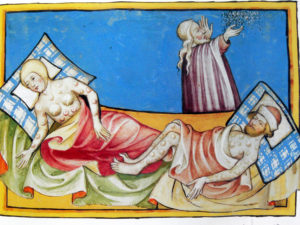
1411 drawing of illness widely believed to be the plague (though the location of bumps more accurately depicts smallpox) from Swiss Toggenburg Bible

It comes in three forms: bubonic, pneumonic, and septicemic. The bubonic strain mainly infected lymph nodes. This caused swelling and buboes in patients, hence the iconic name “Bubonic” Plague by which it is most known. And, popular lore was right: it was spread by rats – more specifically the fleas that traveled on their backs. Likewise, the pneumonic strain infected the lungs and was spread by the breaths of infected victims. The third and least known form is the septicemic strain. It was contracted from flea bites right into the bloodstream where it wreaked havoc on the patient’s life by inducing fever, chills, weakness, abdominal pain, shock, and internal bleeding.


“In order to maintain your peak health, take these precautions: the disease is sometimes transmitted through air due to the awful smell put out from the dead and dying, so if you must go outside, use a handkerchief to cover your face, and dip it in some aromatic oil. It will do you well.”

~ Physician, The Kiss of Death, Chapter Three

The physician who tends to one of Elizabeth’s family members in The Kiss of Death is not entirely inaccurate when he says that the plague traveled through the air, though it wasn’t the smell that made it deadly. Plague particles did spread through the air, aided by coughing and sneezing of infected victims. It was, in fact, the plague’s most effective highway of transmission, as few people knew what we take for granted as simple disease prevention methods today: covering the mouth whenever one coughs or sneezes.

Some people did cover their mouths as the physician suggested, but most were more concerned with warding off the smell of death and disease than any actual prevention. Incense and smelling scents such as juniper and rosemary were particularly popular forms of masking the scent, though they did little in preventing the disease. It’s a wonder that anyone survived in such a time of poor hygiene at all!

But survive, they did. And now, almost 700 years later, here we are to tell their tale.

Sources

—

 Author Bio  

Sarah Natale is the author of The Kiss of Death, her medieval historical fiction debut (Kellan Publishing, 2015). Sarah launched her career as a novelist when she signed with a publisher for the book at age 18. She has always had a fascination for the tragedy that devastated one-third of Europe’s population and was excited to craft a story around the historical event in her senior Creative Writing class, where the idea was born. Her story received a fine arts literary award prior to publication. Sarah is a recent Summa Cum Laude graduate of Drake University, where she studied Writing, Public Relations, and Graphic Design. She is from the suburbs of Chicago where she is at work on a sequel and pursuing an additional career as a book publishing professional.

Website

Facebook

Twitter

Watch the Book Trailer


The Kiss of Death  Synopsis 

Elizabeth Chauncey is a well-off young woman in 14th century London. Though she is considered nobility due to a distant relative, she refuses to think of herself as such. She is close to a childhood friend, Matthias de Bourgueville, with whom she spends much of her time. They have just returned from an outing at the theatre when her world is shaken up.

Suddenly the servants have taken sick, and soon everyone in London is becoming ill with a mysterious disease. People are dying rapidly and the physicians can do little to halt the spread of disease. Elizabeth and Matthias begin to lose family members, causing a rift in their relationship as love and religion come between them. For what kind of God would inflict such pain and cruelty?

Finally, when her home is bolted shut and she and her sick and dying family are trapped inside a Plague House with no escape, Elizabeth is faced with a choice: remain and die, or flee and take cover in the faith that God will protect her. But time is running out, and she is losing hope. To top things off, Matthias has professed his undying love for her and a proposal of marriage. But if they’re all to die anyway, what is the point of going on?

In short, this is a story of a young woman faced with the pain of loss and decision to stay strong in a world that’s destined to destroy her and everything she loves. It is the tale of looking death in the eye and turning the other cheek. But when faith is lost and death is omnipresent, will she refuse its kiss?

Amazon

Barnes & Noble

Kobo

Kellan Publishing


Filed Under: Historical Authors Across Time Tagged With: fiction, history, medieval, plague

Politics, Plots, and Witchcraft-Stories of the Seventeenth Century
July 29, 2018 by Cynthia Ripley Miller Leave a Comment

Today on Historical Authors Across Time, Kate Braithwaite writes about the history, drama, and events of the seventeenth century. I’m so pleased to have her as a guest.

Discovering the Seventeenth Century

With plots and counterplots, royal marriages and infidelities, war and witchcraft, the seventeenth century has it all.

As a life-long reader of all kinds of fiction I always kind of had the idea that I would write a novel one day, but it was a hazy concept. I’ve read a lot of crime fiction and literary fiction and a wealth of historical novels too, but not with any emphasis on any particular period. And while I wanted to write, I really didn’t know what I wanted to write about.

The Affair of the Poisons

That changed when I came across a copy of The Sun King by Nancy Mitford. I had just had my first child and was in need of some non-fiction to give my brain a stretch.  In Mitford’s book I learned about the Affair of the Poisons that consumed Paris and the court of Louis XIV in the late 1670’s. It was wonderful stuff – courtiers living in the opulence of Versailles but working hand-in-glove with the fortune-tellers, poisoners and abortionists of the Parisian underworld. A huge investigation took place, hundreds were arrested and the scandal reached right to the King’s bedchamber when prisoners implicated Louis’ glamorous long-term mistress Athénaïs, Madame de Montespan. After a lot of research, writing and re-writing, this story would become my first novel, Charlatan.


The Popish Plot

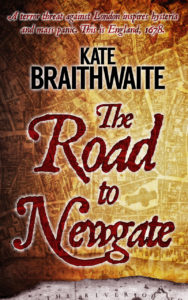
While working on that project, I came across some equally strange and concerning events taking place in London, at the exact same time. I had never heard of Titus Oates but when his name cropped up I took a little research side trip and learned that this previously unknown preacher caused chaos in England’s capital with false claims of a Catholic conspiracy to assassinate Charles II. My second novel, The Road to Newgate, gets up close and personal with Titus Oates, one of the most infamous liars in English history, and charts the attempts of a writer, Nat Thompson, to change public opinion about Oates, even as people are arrested and executed on his say-so. It’s very much a crime novel, based on actual historical events of the Popish Plot, but it’s also about the relationships between the 3 narrators of the story: Nat, the determined writer, his young, naïve wife Anne, and their friend William who has a secret connection to Oates that he is afraid to reveal.

Women & Witchcraft

La Voisin

In the process of writing these two stories, I have learned a great deal about the seventeenth century and found that it’s a fantastic period full of potential stories just waiting to be written. It’s also just far enough back in history to be a world that feels very different from ours. In the early modern period, for example, women’s lives were starkly different: job opportunities were limited, as was access to education or rights to their own money and property. Women’s subservience to men was firmly part of religious teaching. Superstition influenced everyone’s lives, particularly in approaches to health care. In the seventeenth century, people still believed in the Hippocratic principle that four humours – black bile, yellow bile, phlegm, and blood – needed to be balanced in order for a person to be in good health. The medical profession was the province of readers of Latin (largely men) but through tradition and folklore, many people relied on herbal medicine and rituals that seem nonsensical nowadays. In the new world in America and the old in Europe, superstition was challenged with cries of witch-hunt.

The Early Modern Period

Charles II-James II

Yet institutions we recognize today were developing. Political parties were forming in Britain and the upheaval that took place throughout the period resulted in the constitutional monarchy that continues to this day. This was, after all, the century when the British beheaded King Charles I, restored his son, Charles II and then rebelled against his brother James II when he inherited the crown. Literacy exploded and political and religious differences dominated the news sheets as well as consuming London society. People, however, although holding different beliefs and understanding of the world than we do now, were in many ways the same as they are now. Trial transcripts, diaries, letters and contemporary books and pamphlets reveal their voices and concerns and are fascinating sources for fiction writers.

THE ROAD TO NEWGATE – book blurb
What price justice? London 1678. Titus Oates, an unknown preacher, creates panic with wild stories of a Catholic uprising against Charles II. The murder of a prominent Protestant magistrate appears to confirm that the Popish Plot is real. Only Nathaniel Thompson, writer and Licenser of the Presses, instinctively doubts Oates’s revelations. Even his young wife, Anne, is not so sure. And neither know that their friend William Smith has personal history with Titus Oates.
When Nathaniel takes a public stand, questioning the plot and Oates’s integrity, the consequences threaten them all.

ABOUT THE AUTHOR
Kate Braithwaite was born and grew up in Edinburgh, Scotland. Her first novel, Charlatan, was longlisted for the Mslexia New Novel Award and the Historical Novel Society Award. Kate lives in Pennsylvania with her husband and three children.
Website
Facebook
Twitter
Buy the book: mybook.to/theroadtonewgate

Filed Under: Historical Authors Across Time Tagged With: 17th century, history, politics, witchcraft

Mithraism in Ancient Rome: A Soldier’s Religion
June 27, 2018 by Cynthia Ripley Miller 3 Comments

Today, I would like to welcome author, Pam Allegretto. She’s this month’s guest blogger at Historical Authors Across Time, talking about the god, Mithras, and Mithraism in ancient Rome. Learn more about Pamela at the end of this post.


While conducting research for my World War 2 novel Bridge of Sighs and Dreams,I wanted to incorporate some of the ancient underground caverns used by the Resistance to smuggle Italian Jews out of Rome in order to avoid Nazi arrests. The caverns that most interested me were those created by the Worshippers of Mithras.

Mithras
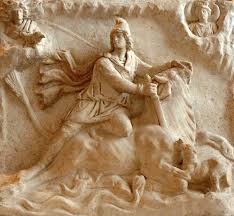
The god Mithras

Who was Mithras?

Mithras is the Latin (and Greek) form of the name of an ancient Iranian god, Mithra. Mithraism began to spread throughout the Roman Empire in the first century AD.
Mithraism’s strongest appeals were its doctrines of the immortality of the soul, the resurrection of the body, and the belief that through Mithra’s help, the faithful would reach heaven. However, the key “secrets” of this “mystery cult” are unknown, as no written sources by members survive. It has been determined that the faithful pledged good moral conduct and brotherly respect regardless of social standing. Slaves and manual laborers might stand higher in the congregation than the aristocracy. Mithraism began as the religion of the poor and servile classes until the second century AD when it was taken up by the Imperial Court and educated classes. Members of the Roman army comprised a large portion of the membership, (some refer to Mithraism as the “soldier’s religion”). As a seemingly all-inclusive religion, Mithraism lacked one large demography: women.

Temples of Worship

Temples of Mithras (Mithraeum) were dug below ground or converted from natural caves. Mithraic temples were common throughout the Roman Empire where Roman legions had been stationed, with considerable numbers found in Rome, Ostia, Numidia, Dalmatia, Britain, and along the Rhine/Danube frontier. In addition, Mithraic temple ruins have been discovered in Greece, Egypt, and Syria.

Because the Mithraic Temples were built underground, their contents and rich iconography have remained well preserved. In every Mithraeum the centerpiece was a representation of Mithras killing a sacred bull: an act called the tauroctony. The image may be either a relief or a freestanding statue with or without accompanying iconography. Mithras is always depicted clothed in Anatolian costume and wearing a Phrygian cap, kneeling on the bull and holding it by the nostrils with his left hand, while stabbing it with his right. As he does so, he looks over his shoulder away from the bull. In some wall iconography, Mithras faces toward the figure of Sol. There are contradictory schools of thought as to the meaning of the tauroctony. One is that the figures represent characters out of Iranian mythology; another premise is that the characters are a series of stars and constellations.

Christianity and Mithraism

It is believed that the rise of Christianity doomed Mithraism due partly to the elaborate initiation rites that limited its numbers of adherents, and to its exclusion of women. Emperor Constantine merged Mithraism with Christianity. Even though he declared himself a Christian, he maintained his ties to the Mithra cult. He retained the title “Pontifus Maximus”the high priest. On his coins were inscribed: “Sol Invicto comiti” which means, “committed to the invincible sun.” This new blend of the two faiths, he officially proclaimed as Christianity.

To read more about this fascinating religion, I recommend: The Origins of the Mithraic Mysteries by David Ulansey, and Life in Ancient Rome by F.R. Cowell. Further information and excellent photographs of Mithraic iconography can be found online at the Wikipedia free encyclopedia.

Bridge of Sighs and Dreams by Pamela Allegretto

Nazi-occupied Rome sets the stage for Bridge of Sighs and Dreams, where the lives of two women collide in an arena of deception, greed, and sacrifice.
Following an allied attack, Angelina Rosini flees to Rome from her bombed-out village and a ruthless Nazi officer bent on revenge. In Rome, the spirited portrait artist channels her creativity into the art of survival for herself and her young daughter. Unwilling to merely endure, and armed with ingenuity, wit, and unyielding optimism, she enters the shadow world of the Resistance where she zigzags through a labyrinth of compassionate allies and cunning spies.

Meanwhile, Lidia Corsini quenches her lust for power and wealth by turning in Jews to the Nazi Police attaché with whom she has formed an alliance. Her spiral into immorality accelerates as swiftly as the Jewish population dwindles, and soon neither her husband nor her son is immune to her madness.

Once Angelina discovers the consequences of Lidia’s greed, she conspires to put an end to the treacheries; but in doing so, she becomes the target of Lidia’s most sinister plot.

Bridge of Sighs and Dreams is a story of betrayal, dignity, and purpose that highlights the brutality toward Italian citizens, under both Mussolini’s Fascist regime and the Nazi occupation, and illustrates the tenacity of the human spirit.

About Pamela Allegretto

In addition to her historical fiction: Bridge of Sighs and Dreams, Pamela’s traditionally published books include L’Alba di Domani, and Immaginiboth are dual-language poetry books written in collaboration with Luciano Somma, two-time winner of Italy’s Silver Medal of the President of the Republic. Her translations are included in four other dual-language poetry books. Her writing has appeared in Italian literary journals that include: The English Anthology of The Italian-Australian Writer’s Literary Academy, Omero, La Mia Isola, and Poeti Nella Societa`.Her art is collected worldwide.

Pamela’s Social Media

Website

Facebook

@PamAllegretto

Links for Purchase

Amazon

Barnes&Noble

Book Locker

Filed Under: Historical Authors Across Time Tagged With: ancient rome, gods, history

The Late Roman Army & The Barbarian Conspiracy
March 3, 2017 by Cynthia Ripley Miller 2 Comments

Reorganization of the Army

The following is a guest post by Brian Kitchen. Learn more about Brian at the end of this post.

The late Roman Army in Britain bore very little resemblance to the army of the Emperor Claudius, which had conquered the island in 43ad. By the late 4th century, the time I write about in my ‘Divided Empire’ series of novels, there had been a complete reorganization of the army.

Caer Gybi Roman Fort

The army in Britain no longer relied solely on the Legions based at York, Chester, and Exeter and auxiliary regiments based in forts throughout the island, which had previously composed the army which had for centuries occupied Britain.

The enemy that the Roman army was now facing was no longer the people of the island it had occupied, but barbarian enemies that were raiding its shores and the forces to meet this new challenge had to change.

From the third century, Britain had periodically suffered raids and incursions from the Empire’s barbarian foes. The Roman historian Eutropius wrote that during the 280s the coasts of Belgica and Armorica (modern day France, Belgium and the Netherlands) were ‘infested with Franks and Saxons’.

To meet the new threats to Britain, a chain of forts was built along the eastern and southern shores of Britain, with some also being built along the west coast too. The forts at Cardiff and Caer Gybi (Anglesey, Wales) may be part of this chain. The Notitia Dignitatum a late Roman Document which lists the army commands in Britain, has the commander of the garrisons of this chain of forts, now known as the ‘Saxon Shore’ command, listed as the Comes Litoris Saxonici per Britanniarum.

In the north of Britain, the army command there had also been reorganised with the forts of Hadrian’s Wall and northern Britain, now coming under the command of the Dux Britanniarum. A chain of signal stations was built along the north-east coast of Britain, the foundations of one of them can still be viewed at Scarborough Castle, Yorkshire.

The Barbarian Conspiracy

The threat to the security of the island was so serious, that the Emperor dispatched a task force from his field army to Britain to assist in restoring order. It is because of this raid that some historians believe that a further new military command was set up in Britain, under the command of the Comes Britanniae.

A listing appears in the Notitia Dignitatum listing the forces under his command, six cavalry regiments and three of infantry, a mobile task force equipped and ready to move throughout Britain to wherever it was required.

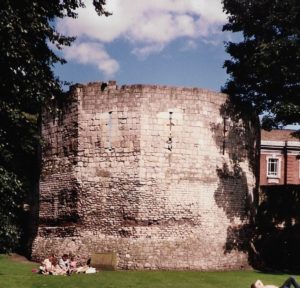
Towns which previously hadn’t been walled before, were also now walled and towers for artillery were added to existing walls. The Multangular Tower which can be viewed in the Museum Gardens in York is an example of the kind of towers which were built to strengthen defences.

Above is a Multangular Tower in YorkDuring the fourth century, the Picts from the north of Britain, the Scots and the enigmatic Attecotti from Ireland and the Franks and Saxons from the continent had plagued Britain with a series of raids. The raids culminated in 367ad in what is known as the ‘Barbarian Conspiracy’, when the Picts, Scots, Attecotti and Saxons made a combined attack on Britain. During the fighting, the Dux Britanniarum was killed, along with what it is thought to have been the Comes Litoris Saxonici.

A lot of the troops now deployed to defend Britain were Limitanei, troops who were stationed in frontier districts, like in the forts along Hadrian’s Wall.

Some historians have suggested that these Limitanei troops may have been part-time soldiers, who were given land to farm during peacetime, being called up for duty when danger threatened.

The Later Roman Army

So, what of the other forces of the Roman Army in Britain, where were they based and what was their composition now? The Roman soldier of the 4th Century looked very different from the Roman Legionary of the early empire. By the late 4th Century the army comprised of more cavalry units than infantry, arising from the need to move quickly to wherever the raiders struck.

Verulamium Roman Walls

Heavier cavalry, such as the armoured Cataphracts and Horse Archers were being increasingly deployed. The weapons and armour of the troops was very different to that of the legionaries and auxiliaries of the earlier empire.

Some infantry now wore no armour, relying on their shields for protection and missile-type weapons like the Plumbata and dart-type weapons were commonly used. A lot of the forts in the interior of Britain were abandoned and more troops were now based in the towns and cities.

In the Roman town of Viroconium (modern day Wroxeter) evidence that troops were based there has been found during excavations, with Plumbata being found in the ruins of the basilica there. For all these changes however, the Western Roman Empire eventually fell to the barbarians and although Britain held out into the 6th century it too also eventually fell.

Brian J Kitchen – Author Bio

I live in Burton upon Trent, England and am married to Lynne and have a son, Mark and two tortoise shell cats, Tansy & Zoe. I enjoy walking in the countryside, photography, reading, writing, visiting museums and historic sites & buildings and supporting Burton Albion.

I first became interested in the history of Roman Britain as a child and loved the ‘Eagle of the Ninth’ trilogy of novels by Rosemary Sutcliff. When I was older I read & studied all that I could about the history of the period, visiting many museums and archaeological sites to further improve my knowledge.

I’ve always had a passion for writing and when I retired from Local Government service, I wrote a column in our local newspaper for two years and also decided to write novels set in late 4th Century CE Roman Britain. The first of the Flavius Vitulasius Novels, ‘Divided Empire’ is my first published novel, but there are many more to come. I hope that you enjoying reading them as much as I’ve enjoyed writing them.

Should you wish to know more about Flavius & his friends, please visit my website, Facebook, and Twitter pages:

Facebook

Website

Twitter (@Oldbrookender)


Links to Brian’s books…

View on Amazon

View on Amazon UK

View on Amazon

View on Amazon UK


Filed Under: Historical Authors Across Time Tagged With: army, history, Roman

The Cat In Ancient Rome

April 17, 2016 by Cynthia Ripley Miller 1 Comment

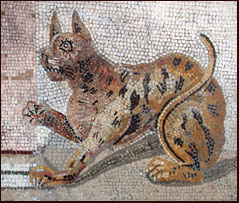
Floor mosaic from House of the Faun, Pompeii.Cat with bird. Ducks and sea life. Museo Archeologico Nazionale Napoli Inv. 9993


A large part of writing a historical novel is the research into the politics, customs and common habits of the time period in which the story is set. One day while watching my twin cats, Romulus and Remus, basking in the sun, I questioned whether the ancient Romans kept cats as pets and how they were viewed.   If the Romans owned cats, did they hold these animals in the same affectionate regard as many people do today?


Cat-mosaic-Pompeii

Here are some facts I discovered:

  • Some experts believe that cats were domesticated from wildcats in Mesopotamia. More evidence points to stronger origins in Egypt.
  • Domestic cats may have reached Rome via trade as far back as the 5th century BC but were difficult to get.
  • Egyptians revered the cat and often made attempts to reclaim cats smuggled out of the country. As Christianity grew, Egyptians began to release their hold on the cat.
  • Early evidence exists for cats as simple house animals in Italy: A 1st century AD grave marker shows a cat referred to as Calpurnia Felicla, thought to translate as ‘pussy’; also in this time period, a relief in the Capitoline Museum in Rome, depicts a woman training a cat to dance to music from a lyre; Plutarch writes about the cat and the weasel as house animals; Pliny advises using a cat to drive away mice, and the agricultural writer, Palladius, recommends the cat for catching moles.
  • Additional evidence in later periods is found in the records of the physician, Evagrius (593AD) about St. Simeon who led a tame panther ‘around on a rope like a tame housecat,’ and in the 6th century epigrams of the poet, Agathias (527 565AD).
  • The overall view of the house cat in ancient Rome leans toward a ‘beast of prey’ more than a cuddly friend.

I’ve owned a variety of pets over the years, which include: dogs, birds, aquarium fish, hamsters, guinea pigs, turtles, and cats. Through these amazing creatures, my family has experienced joy, laughter, wonder, and learning. When I think about which of these lovable pets ranks high with me, I must choose the cat.  Do you have a favorite pet? Share.

IMG_0930
Romulus and Remus

Wikipedia

http://penelope.uchicago.edu

www.playfulkitty.net

#Cats, #pets, #history

Filed Under: Ancient Rome and France Tagged With: Cats, history, pets

A Sword Among Ravens

SwordAmongRavensCover

Amazon
Barnes & Noble
iTunes
Kobo
Booklocker
---

The Quest for the Crown of Thorns

New Historical Romance Novel

Amazon Barnes & Noble iTunes Kobo Booklocker ---

On the Edge of Sunrise

On the Edge of Sunrise - Book One of the Long-Hair Saga
Amazon Barnes & Noble iTunes Kobo Booklocker ---

Categories

  • Ancient Rome and France
  • Historical Authors Across Time
  • Merovingian-Frankish
  • The 5th Century
  • Writing Historical Romance
  • Writing Romantic Historical

Links

My original blog:
Historical Happenings and Oddities

Copyright © 2026 · CynthiaRipleyMiller.com · Designed by Avalon Graphics

Copyright © 2026 · Lifestyle Pro Theme on Genesis Framework · WordPress · Log in