Today, I would like to welcome author, Pam Allegretto. She’s this month’s guest blogger at Historical Authors Across Time, talking about the god, Mithras, and Mithraism in ancient Rome. Learn more about Pamela at the end of this post.
While conducting research for my World War 2 novel Bridge of Sighs and Dreams,I wanted to incorporate some of the ancient underground caverns used by the Resistance to smuggle Italian Jews out of Rome in order to avoid Nazi arrests. The caverns that most interested me were those created by the Worshippers of Mithras.

Who was Mithras?
Mithras is the Latin (and Greek) form of the name of an ancient Iranian god, Mithra. Mithraism began to spread throughout the Roman Empire in the first century AD.
Mithraism’s strongest appeals were its doctrines of the immortality of the soul, the resurrection of the body, and the belief that through Mithra’s help, the faithful would reach heaven. However, the key “secrets” of this “mystery cult” are unknown, as no written sources by members survive. It has been determined that the faithful pledged good moral conduct and brotherly respect regardless of social standing. Slaves and manual laborers might stand higher in the congregation than the aristocracy. Mithraism began as the religion of the poor and servile classes until the second century AD when it was taken up by the Imperial Court and educated classes. Members of the Roman army comprised a large portion of the membership, (some refer to Mithraism as the “soldier’s religion”). As a seemingly all-inclusive religion, Mithraism lacked one large demography: women.
Temples of Worship
Temples of Mithras (Mithraeum) were dug below ground or converted from natural caves. Mithraic temples were common throughout the Roman Empire where Roman legions had been stationed, with considerable numbers found in Rome, Ostia, Numidia, Dalmatia, Britain, and along the Rhine/Danube frontier. In addition, Mithraic temple ruins have been discovered in Greece, Egypt, and Syria.
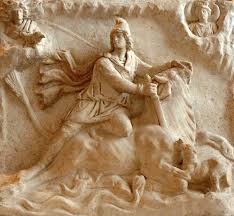
Because the Mithraic Temples were built underground, their contents and rich iconography have remained well preserved. In every Mithraeum the centerpiece was a representation of Mithras killing a sacred bull: an act called the tauroctony. The image may be either a relief or a freestanding statue with or without accompanying iconography. Mithras is always depicted clothed in Anatolian costume and wearing a Phrygian cap, kneeling on the bull and holding it by the nostrils with his left hand, while stabbing it with his right. As he does so, he looks over his shoulder away from the bull. In some wall iconography, Mithras faces toward the figure of Sol. There are contradictory schools of thought as to the meaning of the tauroctony. One is that the figures represent characters out of Iranian mythology; another premise is that the characters are a series of stars and constellations.
Christianity and Mithraism
It is believed that the rise of Christianity doomed Mithraism due partly to the elaborate initiation rites that limited its numbers of adherents, and to its exclusion of women. Emperor Constantine merged Mithraism with Christianity. Even though he declared himself a Christian, he maintained his ties to the Mithra cult. He retained the title “Pontifus Maximus”the high priest. On his coins were inscribed: “Sol Invicto comiti” which means, “committed to the invincible sun.” This new blend of the two faiths, he officially proclaimed as Christianity.
To read more about this fascinating religion, I recommend: The Origins of the Mithraic Mysteries by David Ulansey, and Life in Ancient Rome by F.R. Cowell. Further information and excellent photographs of Mithraic iconography can be found online at the Wikipedia free encyclopedia.
Bridge of Sighs and Dreams by Pamela Allegretto
Nazi-occupied Rome sets the stage for Bridge of Sighs and Dreams, where the lives of two women collide in an arena of deception, greed, and sacrifice.
Following an allied attack, Angelina Rosini flees to Rome from her bombed-out village and a ruthless Nazi officer bent on revenge. In Rome, the spirited portrait artist channels her creativity into the art of survival for herself and her young daughter. Unwilling to merely endure, and armed with ingenuity, wit, and unyielding optimism, she enters the shadow world of the Resistance where she zigzags through a labyrinth of compassionate allies and cunning spies.
Meanwhile, Lidia Corsini quenches her lust for power and wealth by turning in Jews to the Nazi Police attaché with whom she has formed an alliance. Her spiral into immorality accelerates as swiftly as the Jewish population dwindles, and soon neither her husband nor her son is immune to her madness.
Once Angelina discovers the consequences of Lidia’s greed, she conspires to put an end to the treacheries; but in doing so, she becomes the target of Lidia’s most sinister plot.
Bridge of Sighs and Dreams is a story of betrayal, dignity, and purpose that highlights the brutality toward Italian citizens, under both Mussolini’s Fascist regime and the Nazi occupation, and illustrates the tenacity of the human spirit.
About Pamela Allegretto
In addition to her historical fiction: Bridge of Sighs and Dreams, Pamela’s traditionally published books include L’Alba di Domani, and Immaginiboth are dual-language poetry books written in collaboration with Luciano Somma, two-time winner of Italy’s Silver Medal of the President of the Republic. Her translations are included in four other dual-language poetry books. Her writing has appeared in Italian literary journals that include: The English Anthology of The Italian-Australian Writer’s Literary Academy, Omero, La Mia Isola, and Poeti Nella Societa`.Her art is collected worldwide.


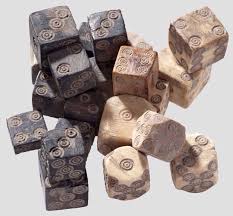
Dice (Tesserae) was a gambling game. Players rolled the dice and bet on the results. Roman dice were different from modern dice in that the numbers on any two opposite sides added up to seven. Like today, dice were shaken in a cup and tossed onto a table. People also placed bets. Paintings found on ancient Roman walls show that they played with three dice.
The game of marbles called Nux ‘nuts’ originates with the pagan Roman feast of Saturnalia (Winter Solstice), which was eventually replaced by Christmas in Christianized late ancient Rome. People would give each other bags filled with nuts and marbles. Children loved playing Nux and there are references by Roman writers to the game. One account speaks of how the emperor Romulus Augustus ‘played the game as a child.’ The rules of the game have been lost, but some form of it might be seen in modern European games like ‘Ring Taw’ and ‘Archboard’ which requires a player to roll their marbles at a ‘bridge with nine Roman arches.’ The arches are numbered with a Roman numeral from 1 (I) to 9 (IX) and whichever arch a marble rolls through, the player ‘scores the number of points shown at the top of the arch.’ 45 is the total amount of points required to win. Marbles were most often made of clay, stone or glass.
that involved moving ‘pebbles from one square to another in a grid.’ Evidence of these grids has been found ‘scratched into floor stones and floor tiles all over the Roman Empire, in houses, and by guardhouses, and in amphitheaters, wherever men or women, boys or girls, had some time to waste.’
They also played a game called Latrunculi a Roman form of chess. It used a board made either of wood, marble, stone, or silver, and black and white army pieces that fight it out. There was also another game similar to chess called Pebbles because you could use anything as a piece. The goal was to advance square by square and surround your opponent’s pieces with two of your own ‘either vertically or horizontally or diagonally.’
A game played in ancient Rome and close to tic-tac-toe is known as Rota meaning ‘wheel.’ Rota boards could be easily ‘scratched or scribbled’ anywhere where Romans went. It’s a three-in-a-row game like tic-tac-toe but different in that it cannot end in a tie. Another game also similar to tic-tac-toe from the first century BC was called Terni Lapilli. This form used three playing pieces that had to be moved into empty spaces. ‘Grid markings have been found chalked all over Rome.’