• Home
  • About My Books
    • A Sword Among Ravens
    • The Quest for the Crown of Thorns
    • On the Edge of Sunrise
    • Resources
  • Events
  • Biography
  • Historical Romance
  • Blog
    • Cynthia’s Posts
    • Historical Authors Across Time
  • Contact

Children in Early and Late Ancient Rome

April 30, 2023 by Cynthia Ripley Miller Leave a Comment

Children at Play

Writing my series, The Long-Hair Saga, set in late ancient Rome, Gaul, and Jerusalem in the 5th century, has required years of research. My heroine, Lady Arria, is an only child and a Roman senator’s daughter unconventionally educated, beyond the domestic arts and scriptures, because of her exceptional aptitude and interpersonal skills. Her counterpart, Garic, is a Germanic barbarian, Frank noble (known as Long-Hairs), also educated and First Counsel to his tribe. Throughout the series, both heroes encounter social issues that affect their mission, mutual attraction, and the events around them. Caught up in intrigue, politics, mystery, and adventure, they also experience slavery, the exploitation of children, prejudice based on class and ethnicity, religious differences, war, and death. For me, this study has been a fascinating time travel through the lives of my characters and the seed for creating a well-rounded story and world.

Along the way, an area that became interesting to me was the treatment of children and their status. The modern-day view of children’s welfare and status is quite different and, thankfully, much better. Over time, the evolution of parenting within cultural groups and how children are regarded has changed and improved. In modern society, it would be criminal if a parent tried to sell their child. In the ancient world, the sale of a child was not necessarily considered horrific, but rather viewed as benevolent or necessary for that child’s survival in some situations.

How Did the Roman World View Children?

Early Roman views about the status and welfare of children were much different from some of the views held today. Nonetheless, there were laws concerning their status and what was acceptable treatment. Later in the 4th-century Christian Roman world, some laws, practices, and beliefs supported by the Christian church regarding children changed, but many remained in place.

The primary reason for marriage was to produce legitimate children in status as free persons and Roman citizens for the family’s security, which was a core belief. A child born outside of marriage would be of questionable status and inheritance. Within the law, a father would decide within eight days if whether the child would live or ‘be exposed’, which meant death or anonymously taken by another. Some factors regarding a father’s decision included physical and mental defects, legitimacy of the child, or to keep the family small for financial reasons. Boys were favored over girls because they didn’t require dowries and were often considered more productive family members. Another way to produce an heir necessary for the family’s longevity and wealth was through adoption. The adoptee, either adult or child, was then considered the successor.

Raising a child, especially in the early years, was important to parents. Epigraphs and historical medical accounts show that parents, ‘at least among the upper classes,’ had strong parental concerns and emotional attachment. However, according to Geoffrey Nathan in his book The Family in Late Antiquity, after the age of seven was not ‘purely the position of the loved youth’ for a child. Their labor was an investment for the rich and poor. Most of the community was rural, and child labor meant help on farms of various sizes. Urban children, especially the lower classes, had a similar situation within their family professions. If a father or paterfamilias had many male children, it was acceptable to sell them into slavery, or boys and girls could be placed into ‘indentured servitude or apprenticeship, or simply hire them out to a creditor.’

Caring for parents, especially in their older age, was also expected of children. Participating in the family and becoming successors ‘assured a father’s immortality by the transmission of property and by ritual remembrance.’ Children were also responsible for ensuring their parents had a proper burial.

Children of the upper classes were groomed for many responsibilities in either business or public affairs. They must honor their ancestors in the home and on specific holidays. They should marry or divorce at their father’s will. In some cases, a child might object, but it was the father who contracted the marriage. They were also expected to advance the family’s reputation and riches because there was a deep belief in the transmission of property and wealth from one generation to the next. In the law and Roman beliefs, children were under a father’s control and protection. A father was required to behave responsibly towards his children and make sure his daughter married a man who would not abuse her, exact reasonable discipline, and value mercy.

Ancient Roman Views on Discipline 

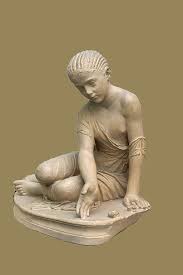
Roman girl playing a game

Discipline was different for slave and free-born children. Slaves were more likely to be whipped than free-born children. Experts disagree to what degree whipping or beating was used as a form of discipline. Some authors think it was a form of punishment meant only for slaves to punish certain behaviors. That whipping free-born students was a bad practice, advancing a slave mentality, and ‘It was an affront on a person’s dignitas’and considered a ‘repulsive’ action.

However, according to Nathan, ‘The realities of disciplining a boy (and occasionally a girl) were replete with beatings of every sort.’ Yet Classical authors admonished parents to think and show patience before punishing their children.

In the fourth century and late Christian Empire, some of the practices fully accepted by the society regarding children changed. One of the policies that the church legislated and restated in canon law was restrictions against the sale and exposure of children. Objections to child trafficking reached as far back as the second century.

The practice of selling children or exposure was considered a final action or sale to prevent parents from rashly selling or exposing their children. Now, two canons, nine and ten, in accordance with Honorius’ law, ordered that authorities should take exposed children to a church. If not reclaimed in ten days, they belonged to the finder. Parents who later tried to recover their children would be ‘condemned as murderers’ and the finder ‘slandered.’ The church hoped that the permanence of sale and exposure would keep parents from making hasty decisions.

Generally, the sales of free-born children had been illegal in the early Empire, but in the fourthcentury, Valentinian II permitted this practice on a temporary basis first out of familial need. Later, in the fifth century, Valentinian III allowed it due to a terrible famine that plagued the countryside. Both emperors also enacted measures that provided parents the ability to recover these children easily. However, the policy outlawing or discouraging the barter of free individuals remained.

In the late century, more care was given to the welfare of orphans by the church and securing the freedom of poor free-born children and adults who were bought or stolen by ‘slave traders or kidnapped by barbarians.’ The demand for slaves was high, and their prices were not cheap. ‘For this reason, the government in the sixth century permitted local churches to pawn church property as a guarantee for freeing slaves.’ These actions extended to children and adults. Consequently, children remained in society’s borders, but even more than women, they remained on the edges of society.

In conclusion, historical opinions and views in the late Roman Empire concerning children and the parent-child relationship suggest that parents seemed to pay closer attention to their children’s upbringing. It included personally supervising ‘to correct poor behavior, a strong interest in a child’s basic moral education, and a certain responsibility placed on the parent should that child fail to live up to the expectations of family and society.’ The idea was that the father prepared a child for living in the world, and the mother ‘trained it for the next.’ It appears that as the Empire aged, many things did not change, but the care of the children improved, and Christian parents took greater responsibility for the nurturing of their children.

Resources

The Family in Late Antiquity, Nathan, Geoffrey (Routledge 2000)

Handbook to Life in Ancient Rome, Adkins, Lesley and Roy A. (Oxford University Press 1998)

Filed Under: Ancient Rome and France

Ancient Roman Board Games

May 10, 2017 by Cynthia Ripley Miller

What would the modern person do if television, the movies, Social Media, sports, and music events didn’t exist?  Chances are we might spend our time playing more board games just like the ancient Romans.

The ancient Romans loved board games.

Some of the more common board games played by ancient Romans were dice, knucklebones, marbles, and a form of checkers, chess, tic-tac-toe, and backgammon.

Let ‘em roll!

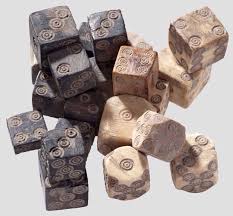
Dice (Tesserae) was a gambling game.  Players rolled the dice and bet on the results. Roman dice were different from modern dice in that the numbers on any two opposite sides added up to seven.  Like today, dice were shaken in a cup and tossed onto a table. People also placed bets. Paintings found on ancient Roman walls show that they played with three dice.

Tali is the Latin name for knucklebones, and the Greeks called them Astragaloi. ‘Like most Roman and Greek games, tali was first played in ancient Egypt,’ and were discovered in ancient Egyptian tombs. The first pieces were made from the knucklebones of sheep and goats, but the Romans also made them from marble, wood, glass, precious metals and gems. When the tali are tossed ‘each fall on one of four sides’ resembling the modern game of dice.

The game of marbles called Nux ‘nuts’ originates with the pagan Roman feast of Saturnalia (Winter Solstice), which was eventually replaced by Christmas in Christianized late ancient Rome. People would give each other bags filled with nuts and marbles. Children loved playing Nux and there are references by Roman writers to the game. One account speaks of how the emperor Romulus Augustus ‘played the game as a child.’ The rules of the game have been lost, but some form of it might be seen in modern European games like ‘Ring Taw’ and ‘Archboard’ which requires a player to roll their marbles at a ‘bridge with nine Roman arches.’ The arches are numbered with a Roman numeral from 1 (I) to 9 (IX) and whichever arch a marble rolls through, the player ‘scores the number of points shown at the top of the arch.’ 45 is the total amount of points required to win. Marbles were most often made of clay, stone or glass.

Get on board—Squares, Grids, and Spaces.

The Romans played a form of checkers where the player had to get 5 stones in a row to win and games that involved moving ‘pebbles from one square to another in a grid.’ Evidence of these grids has been found ‘scratched into floor stones and floor tiles all over the Roman Empire, in houses, and by guardhouses, and in amphitheaters, wherever men or women, boys or girls, had some time to waste.’

They also played a game called Latrunculi a Roman form of chess. It used a board made either of wood, marble, stone, or silver, and black and white army pieces that fight it out. There was also another game similar to chess called Pebbles because you could use anything as a piece. The goal was to advance square by square and surround your opponent’s pieces with two of your own ‘either vertically or horizontally or diagonally.’

A game played in ancient Rome and close to tic-tac-toe is known as Rota meaning ‘wheel.’ Rota boards could be easily ‘scratched or scribbled’ anywhere where Romans went. It’s a three-in-a-row game like tic-tac-toe but different in that it cannot end in a tie. Another game also similar to tic-tac-toe from the first century BC was called Terni Lapilli. This form used three playing pieces that had to be moved into empty spaces. ‘Grid markings have been found chalked all over Rome.’

Lastly, a board game that any class of Romans could play was called Lucky Sixes. In each column/row there were six figures that resembled numbers, letters, or even pictures. When put together, they formed a philosophical phrase or joke. Lucky Sixes resembles the modern game of Backgammon because players started at the opposite side of the board and threw dice or sticks ‘to move pieces to their opponent’s side.’

A world without games is no fun at all!

Even in the ancient world, and not just the Roman Empire, man enjoyed sporting pastimes and games. Playing games was most likely a pleasant escape from the job of daily survival. On a hot sunny day under a merchant’s awning or in an icy-cold barracks, a game of marbles or dice must have added to life, and especially if there was money to be won. Bingo!


Pete Di Primo, Ancient Rome; K.E. Carr, ‘Roman Dice Games, Quatr.com; ‘The Origin of the Game of Marbles’ magwv.com; Boardgames.lovetoknow.com; Mental floss.com;Praetorian.com; Tic-Tac-Toe Wikipedia.com

Filed Under: Ancient Rome and France Tagged With: ancient rome, board games

The Cat In Ancient Rome

April 17, 2016 by Cynthia Ripley Miller 1 Comment

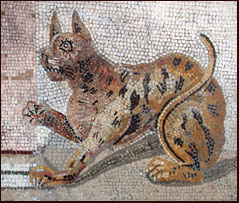
Floor mosaic from House of the Faun, Pompeii.Cat with bird. Ducks and sea life. Museo Archeologico Nazionale Napoli Inv. 9993


A large part of writing a historical novel is the research into the politics, customs and common habits of the time period in which the story is set. One day while watching my twin cats, Romulus and Remus, basking in the sun, I questioned whether the ancient Romans kept cats as pets and how they were viewed.   If the Romans owned cats, did they hold these animals in the same affectionate regard as many people do today?


Cat-mosaic-Pompeii

Here are some facts I discovered:

  • Some experts believe that cats were domesticated from wildcats in Mesopotamia. More evidence points to stronger origins in Egypt.
  • Domestic cats may have reached Rome via trade as far back as the 5th century BC but were difficult to get.
  • Egyptians revered the cat and often made attempts to reclaim cats smuggled out of the country. As Christianity grew, Egyptians began to release their hold on the cat.
  • Early evidence exists for cats as simple house animals in Italy: A 1st century AD grave marker shows a cat referred to as Calpurnia Felicla, thought to translate as ‘pussy’; also in this time period, a relief in the Capitoline Museum in Rome, depicts a woman training a cat to dance to music from a lyre; Plutarch writes about the cat and the weasel as house animals; Pliny advises using a cat to drive away mice, and the agricultural writer, Palladius, recommends the cat for catching moles.
  • Additional evidence in later periods is found in the records of the physician, Evagrius (593AD) about St. Simeon who led a tame panther ‘around on a rope like a tame housecat,’ and in the 6th century epigrams of the poet, Agathias (527 565AD).
  • The overall view of the house cat in ancient Rome leans toward a ‘beast of prey’ more than a cuddly friend.

I’ve owned a variety of pets over the years, which include: dogs, birds, aquarium fish, hamsters, guinea pigs, turtles, and cats. Through these amazing creatures, my family has experienced joy, laughter, wonder, and learning. When I think about which of these lovable pets ranks high with me, I must choose the cat.  Do you have a favorite pet? Share.

IMG_0930
Romulus and Remus

Wikipedia

http://penelope.uchicago.edu

www.playfulkitty.net

#Cats, #pets, #history

Filed Under: Ancient Rome and France Tagged With: Cats, history, pets

Roman Jewelry: Brooches and Fibulas

August 22, 2015 by Cynthia Ripley Miller Leave a Comment

Ancient Cameo of Medusa

Men and women all over the world partake in the custom of wearing some kind of adornment or jewelry.  In the modern era, men and women may wear watches, rings, necklaces, wristbands and bracelets.  In the past, men and women also wore a variety of jewelry as marks of distinction or as adornments.  I wear a gold necklace that holds charms of significance.  In the same tradition as the Romans, I own a cameo (a favorite among Romans for its beauty), a marriage ring, and a watch whose face is a gold coin (jewelry made from gold coins was another Roman preference).  In a similar barbarian custom, I have pierced earlobes for earrings.

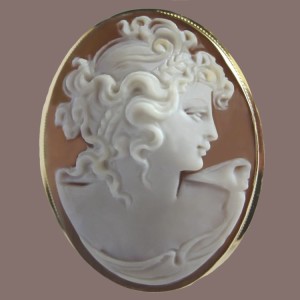
Modern Cameo brooch
Modern Cameo brooch –
You can buy this at Amazon today

For those who enjoy the exquisite beauty of a classic cameo brooch, notice how this contemporary cameo echoes the ancient raised portrait of Medusa. They both have similar serpentine flourishes in white against a darker background. It’s still very much in style, 1,500 years later. In fact you can buy many fine variations at Amazon today, including this one.


Roman Fibulas

Fibula - an early decorative and functional pin for clothing
Fibula – an early decorative and functional pin for clothing

Since the beginning of time, man has had to hold cloth together, especially after he started wearing cloth to cover his body.  It is thought that thorns and flint found in Paleolithic age caves acted as the first ‘pins.’  The word ‘pin’ is the more common term that includes brooches and fibulas.  Brooches or Fibulas (the older historical term) is the oldest type of jewelry that has both a utilitarian and decorative purpose.  The fibula is the most ‘sharply defined in its historical usage while the meanings of pins and brooches have a much wider scope over time.’

Jeweled fibulas, decorative brooches to fasten clothing

The fibula had a necessary function: to fasten clothing together such as cloaks and draped garments.  A clasp with a ‘simple pin, spring, and catch-plate mechanism’, the fibula somewhat resembles a modern day safety pin in its structural design.  Some believe that the safety pin developed from the fibula.  In the ancient and classical periods, there was no gender association to the fibula, but in modern times the brooch is worn by women as a decorative jewelry.

Merovingian Fibulas, decorative brooches

In the fifth century AD (the setting for my story) the fibula was worn by both men and women.  They had a practical usage but could be decorative as well.  The Roman and barbarian soldier might use a plainer pin that could withstand all kinds of wear, but the nobles also wore ‘elaborately decorated bow-shaped clasps with long thin sheaths covering the pin.’  Fibulas were made of gold, silver and bronze, worked with filigree, enamel and embellished with gemstones.

My hero, Garic, wears a Frankish style fibula/brooch to pin his cloak together and armlets that are engraved with an emblem of the Royal Bee, which later became a Merovingian symbol.

Roman coin bracelet
Roman coin bracelet – still available at Amazon!

My heroine, Arria, also wears a decorative brooch, rings, hairpins and a gold cross, a gift from her father. Also popular in her time were Roman coins of the realm fashioned into jewelry, rather like this modern gold coin bracelet. This replica was inspired by the ancient coins the Romans crafted into jewelry. Made of rose gold, pure white gold, and rich yellow gold it’s sure to shine on anyone’s wrist today just as it did then.

Why do humans love to adorn themselves?  Some experts believe it’s a way of representing age, gender, family and status.  Others say it’s a way of communicating some of our basic needs, such as our desire for self-expression, religious/spiritual beliefs, and romantic attraction.  What about you?  Do you have a favorite piece of jewelry that reflects ancient times or just some connection to the past?  Share it.  I’m curious to hear.

Filed Under: Ancient Rome and France

Valentine Magic-Roman Love Potions & The Desire to Possess

February 7, 2015 by Cynthia Ripley Miller Leave a Comment

The idea of a magic charm, spell, or potion aiding the pining lover in his/her quest to win the love of their desired one reaches far into the past.  In a modern context, perhaps charms and spells are not prevalent today, but products abound in the form of sexual enhancement lotions, stimulants, and drugs.

Aphrodite the goddess of love (Roman-Venus) can claim the name ‘Aphrodisiac,’ a food, drink or drug that stimulates sexual desire.  These ancient stimulants have been associated with certain foods such as oysters, honey, and figs, (even today, doctors are spouting the benefits of watermelon as increasing blood flow to erectile tissue in both male and female, which increases arousal).

According to History of Magic, in ancient times, women favored the love potion whereas men Roman love potionleaned more toward spells that induced love and affection and the ‘benefits’ that came with them.  ‘Potion’ comes from the Latin word ‘potio’ meaning ‘to drink.’  Potions from ancient Rome and Greece included ingredients such as ‘bats’ blood, crushed beetles, feathers, bird and animal claws, snake skeletons or skins, and many different herbs.’

When it comes to drink, the ancient Romans ‘swore by a brew of delicately aromatic orchid leaves,’ and the easiest of potions included wine in the right amount and stages to ensure success (too little would make for just happiness and too much for impotence or sleep).  ‘Herbal aphrodisiacs and mood enhancers such as oleander, cyclamen and mandrake were also used in combination with wine for enhancements.’ Plants, herbs and flowers — such as fennel, anise and chrysanthemums — are also purported to be erotic pick-me-ups.  Often narcotics were used in potions.

Get Your Sweat On

Roman aphrodisiac from gladiator sweatFinally, I found an interesting post by the Roman mystery writer, Caroline Lawrence, that mentions that some believe the mixture of oil and sweat scraped from a gladiator’s body known as gloios in Greek and strigmentum in Latin was used as a love potion.  She heard this tale from a guide, while visiting Pompeii. Although Lawrence writes there is no hard proof for believing that gladiator sweat was an aphrodisiac, she does cite Pliny the Elder from his work, Natural History. He wrote that small amounts of strigmentum changed hands ‘for the equivalent of a half a million dollars.’

With Valentine’s Day just around the corner, this might be the time to reassess what you’re getting for your sweetheart or may I be bold enough to suggest sweatheart?

Just a little oil might do the trick.

 Resources

  • http://www.besthealthmag.ca/best-you/relationships
  • http://www.wondersandmarvels.com
  • http://www.historyofmagicintrohol.moonfruit.com

Filed Under: Ancient Rome and France Tagged With: Love, passion, romance, sex

A Sword Among Ravens

SwordAmongRavensCover

Amazon
Barnes & Noble
iTunes
Kobo
Booklocker
---

The Quest for the Crown of Thorns

New Historical Romance Novel

Amazon Barnes & Noble iTunes Kobo Booklocker ---

On the Edge of Sunrise

On the Edge of Sunrise - Book One of the Long-Hair Saga
Amazon Barnes & Noble iTunes Kobo Booklocker ---

Categories

  • Ancient Rome and France
  • Historical Authors Across Time
  • Merovingian-Frankish
  • The 5th Century
  • Writing Historical Romance
  • Writing Romantic Historical

Links

My original blog:
Historical Happenings and Oddities

Copyright © 2025 · CynthiaRipleyMiller.com · Designed by Avalon Graphics

Copyright © 2025 · Lifestyle Pro Theme on Genesis Framework · WordPress · Log in