• Home
  • About My Books
    • A Sword Among Ravens
    • The Quest for the Crown of Thorns
    • On the Edge of Sunrise
    • Resources
  • Events
  • Biography
  • Historical Romance
  • Blog
    • Cynthia’s Posts
    • Historical Authors Across Time
  • Contact
You are here: Home / Blog

Roman Jewelry: Brooches and Fibulas

August 22, 2015 by Cynthia Ripley Miller Leave a Comment

Ancient Cameo of Medusa

Men and women all over the world partake in the custom of wearing some kind of adornment or jewelry.  In the modern era, men and women may wear watches, rings, necklaces, wristbands and bracelets.  In the past, men and women also wore a variety of jewelry as marks of distinction or as adornments.  I wear a gold necklace that holds charms of significance.  In the same tradition as the Romans, I own a cameo (a favorite among Romans for its beauty), a marriage ring, and a watch whose face is a gold coin (jewelry made from gold coins was another Roman preference).  In a similar barbarian custom, I have pierced earlobes for earrings.

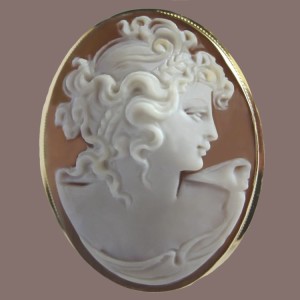
Modern Cameo brooch
Modern Cameo brooch –
You can buy this at Amazon today

For those who enjoy the exquisite beauty of a classic cameo brooch, notice how this contemporary cameo echoes the ancient raised portrait of Medusa. They both have similar serpentine flourishes in white against a darker background. It’s still very much in style, 1,500 years later. In fact you can buy many fine variations at Amazon today, including this one.


Roman Fibulas

Fibula - an early decorative and functional pin for clothing
Fibula – an early decorative and functional pin for clothing

Since the beginning of time, man has had to hold cloth together, especially after he started wearing cloth to cover his body.  It is thought that thorns and flint found in Paleolithic age caves acted as the first ‘pins.’  The word ‘pin’ is the more common term that includes brooches and fibulas.  Brooches or Fibulas (the older historical term) is the oldest type of jewelry that has both a utilitarian and decorative purpose.  The fibula is the most ‘sharply defined in its historical usage while the meanings of pins and brooches have a much wider scope over time.’

Jeweled fibulas, decorative brooches to fasten clothing

The fibula had a necessary function: to fasten clothing together such as cloaks and draped garments.  A clasp with a ‘simple pin, spring, and catch-plate mechanism’, the fibula somewhat resembles a modern day safety pin in its structural design.  Some believe that the safety pin developed from the fibula.  In the ancient and classical periods, there was no gender association to the fibula, but in modern times the brooch is worn by women as a decorative jewelry.

Merovingian Fibulas, decorative brooches

In the fifth century AD (the setting for my story) the fibula was worn by both men and women.  They had a practical usage but could be decorative as well.  The Roman and barbarian soldier might use a plainer pin that could withstand all kinds of wear, but the nobles also wore ‘elaborately decorated bow-shaped clasps with long thin sheaths covering the pin.’  Fibulas were made of gold, silver and bronze, worked with filigree, enamel and embellished with gemstones.

My hero, Garic, wears a Frankish style fibula/brooch to pin his cloak together and armlets that are engraved with an emblem of the Royal Bee, which later became a Merovingian symbol.

Roman coin bracelet
Roman coin bracelet – still available at Amazon!

My heroine, Arria, also wears a decorative brooch, rings, hairpins and a gold cross, a gift from her father. Also popular in her time were Roman coins of the realm fashioned into jewelry, rather like this modern gold coin bracelet. This replica was inspired by the ancient coins the Romans crafted into jewelry. Made of rose gold, pure white gold, and rich yellow gold it’s sure to shine on anyone’s wrist today just as it did then.

Why do humans love to adorn themselves?  Some experts believe it’s a way of representing age, gender, family and status.  Others say it’s a way of communicating some of our basic needs, such as our desire for self-expression, religious/spiritual beliefs, and romantic attraction.  What about you?  Do you have a favorite piece of jewelry that reflects ancient times or just some connection to the past?  Share it.  I’m curious to hear.

Filed Under: Ancient Rome and France

Meroveus, a Merovingian King

March 22, 2015 by Cynthia Ripley Miller Leave a Comment

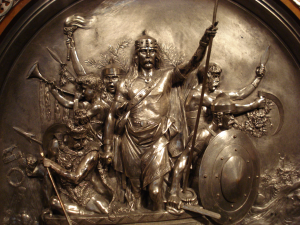
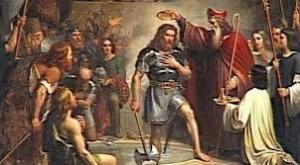
Victory_of_King_MerovechThe Merovingian Dynasty gave birth to the nation of France.  Merovingian, the title given to the Franks, derives from the name Meroveus/Merovech.  Gregory of Tours mentions Meroveus as the son of Chlodio, the first king of the Salian Franks.  Around 450, Meroveus went to Rome to gain support from the Romans for succession as king against an elder brother who aligned with Attila the Hun for the same reason.  Priscus, a Roman diplomat and historian, wrote of Meroveus, “I have seen him, he was still very young and we all remarked his fair hair which fell upon his shoulders.”  This statement supports the idea that Frank nobles distinguished themselves from the commoner and other groups by wearing longer hair, despite the fashion, and were called ‘Long-hairs.’  The Roman Master of the Soldiers, Flavius Aetius, welcomed Meroveus and accepted him as a friend and foederatus (Roman subsidized barbarian warrior).  The Salian Franks fought with Rome at the Battle of Catalaunum (also known as the Battle of the Catalaunian Plains or Châlons).

There are several legends derived from an earlier one recorded in a seventh- century history that states ‘Clodion (Chlodio) was sitting on the seashore together with his wife during the summertime when his spouse, while going into the sea to bathe, was attacked by a sea monster which was like a centaur.  Having become pregnant at once, she gave birth to a son named Meroveus.  In literature, a form of the legend was ‘adapted’ in the book Holy Blood, Holy Grail in which the authors maintain that Meroveus being born of a ‘fish’ meant that the Merovingian line was descended from Christ’s bloodline represented through the Christian symbol of the fish.  The author, Dan Brown, popularized this theory in his novel, The Da Vinci Code.  In researching the Franks and Merovingians, I found the account of Meroveus standing before the Roman elite quite intriguing and it pushed me further into the fascinating history of the 5th century.